
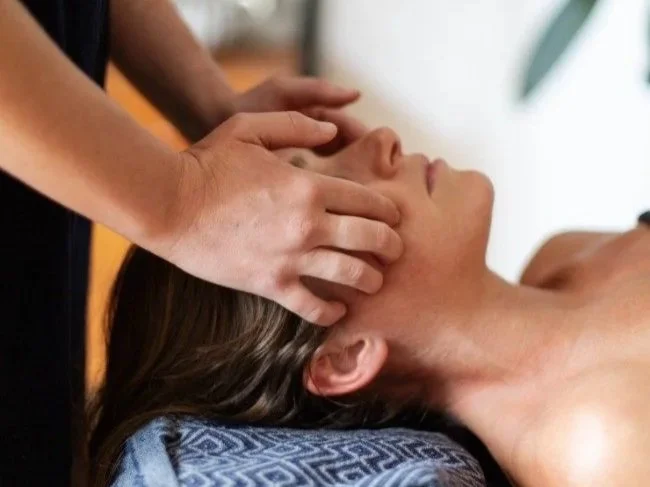
MAssage for Jaw Pain
It all begins with an idea.
Massage for Jaw Pain
Jaw pain is often treated as a local problem: tight masseters, an irritated TMJ, maybe stress clenching at night. While those factors matter, they don’t tell the whole story. If we look at jaw pain as part of a larger, interconnected fascial system—one that links the jaw to the neck, shoulders, spine, and even the feet. We start to get a more complete picture of not just what is hurting, but why. When we shift our perspective from isolated muscles to whole-body fascial lines, massage for jaw pain becomes more effective, more sustainable, and often more surprising.
Rethinking Jaw Pain: Beyond the TMJ
The temporomandibular joint (TMJ) is one of the most complex joints in the body, designed to speak, chew, swallow, and express emotion. Because it’s used constantly, it’s highly sensitive to imbalance elsewhere.
Tension rarely exists in isolation. Fascia—the connective tissue that wraps and links muscles—transmits strain throughout the body. When one area adapts to stress, others compensate. Jaw pain, then, may be less about what’s happening in the jaw and more about what’s happening through it.
Common contributors include:
Forward head posture
Shoulder and chest tightness
Chronic stress patterns
Breathing restrictions
Pelvic or spinal imbalances
Massage that focuses only on the jaw muscles may provide short-term relief, but lasting change often requires addressing these broader patterns. Like a puzzle, the jaw itself is only part of the picture, and we need to find all of the connecting pieces to build lasting relief. We can look locally at the jaw itself, but also further along these fascial chains to the hips, neck & shoulders, diaphragm & pelvic floor. At breathing patterns and stress management.
What Fascial-Informed Massage for Jaw Pain Looks Like
A session may still include careful, respectful work around the jaw itself:
Masseter and temporalis muscles
Suboccipital region
Sternocleidomastoid and scalenes
Intraoral techniques (when appropriate)
But it also expands outward to include:
Chest and rib mobility
Neck and throat fascia
Upper back and shoulder girdle
Hips & pelvis
Breath awareness and nervous system regulation
The goal becomes restoring balanced tension across the entire system so the jaw no longer has to overwork.
The Role of the Nervous System
We know that jaw pain is closely tied to the stress response. Clenching, grinding, and facial tension are classic signs of sympathetic nervous system dominance.
Fascial massage works not only mechanically but neurologically. Slow, sustained touch along fascial lines helps:
Reduce threat signals
Improve proprioception
Encourage parasympathetic (rest-and-digest) activity
When the body feels safer, the jaw often softens on its own.
A More Integrated Path to Relief
Jaw pain can be frustrating & persistent, but by viewing it through a fascial lens, we honor the body’s interconnected design, and there is so much scope for change. The jaw is not an isolated hinge—it’s a participant in a dynamic, whole-body conversation. Massage informed by fascial lines offers more than symptom relief. Over time It supports easier breathing, reduced stress, and a renewed sense of coherence in the body.
And often, when the rest of the system finds balance, the jaw finally gets to rest.
Booking with me for jaw pain:
You are very welcome to book individual treatments with me and we can discuss options, or feel free to contact me HERE if you have any questions. I would recommend 6 sessions for the full benefit; consistency pays off and fascial changes take time. This also enables us to work together and for me to offer supportive homework in between sessions. To keep things simple, and help you stay regular with treatments I’ve put together the Massage for jaw pain Package. This includes 3 x Facial Massage with Intraoral and 3 x 60 body massages. You can find out more HERE